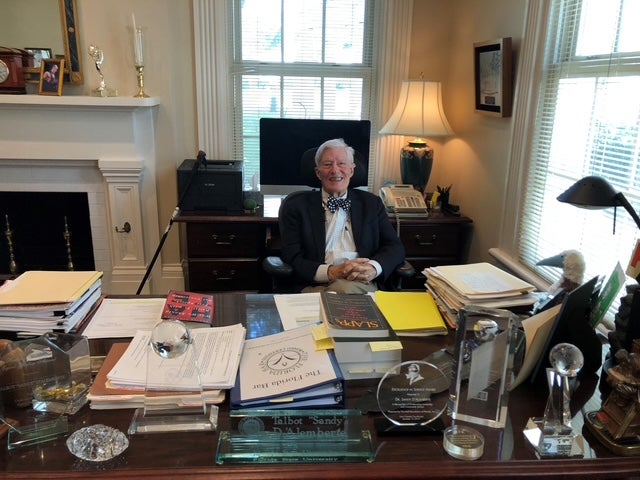
Talbot “Sandy” D’Alemberte left a profound legacy not only at the College of Law, but at Florida State as a whole. A pioneer of change, he continues to inspire the FSU community through his creations and influence.
D’Alemberte was born in Tallahassee, Florida, and raised in both Tallahassee and Chattahoochee. In 1955, he received a bachelor’s degree in political science from the University of the South in Sewanee, Tennessee.
In between completing his undergraduate studies and starting law school, D’Alemberte served as a lieutenant in the U.S. Navy and then studied on a Rotary Foundation fellowship at the London School of Economics.

After completing law school at the University of Florida in 1962, D’Alemberte moved to South Florida to practice law at Steel Hector & Davis. From 1966 to 1972, D’Alemberte represented Dade County in the Florida House of Representatives.
While in private practice in 1975, D’Alemberte petitioned the Florida Supreme Court to allow video cameras in Florida courts, which was granted in 1979. This change is believed to be the nation’s broadest and most innovative rule allowing cameras in courtrooms.
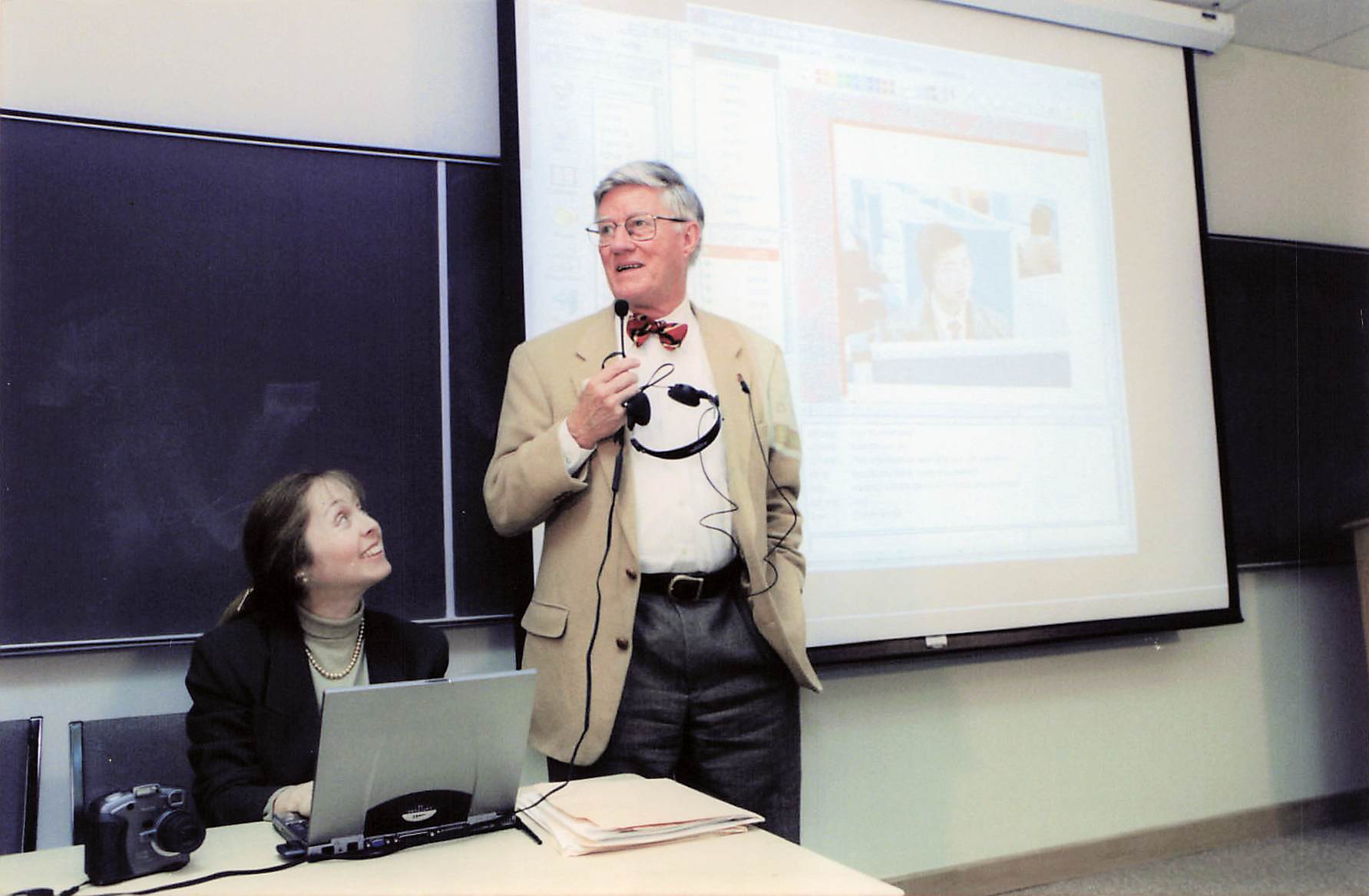
D’Alemberte joined FSU in 1984 as the fourth Dean of the College of Law. During his tenure as Dean, he placed great value on community service and emphasized the importance of helping those who could not afford a lawyer.
Under his leadership, the academic profile and national reputation of FSU Law rose significantly. By using funds allocated from the Florida Legislature aimed at enhancing legal education, he was able to expand the faculty with a new generation of dynamic legal scholars. He also instituted a pro bono requirement for graduation, a practice that has since become common across law schools nationwide.
One of D’Alemberte’s most notable accomplishments as Dean was his mission to expand and beautify the law school. Inspired by Thomas Jefferson’s “Academical Village,” D’Alemberte envisioned the Village Green and Rotunda as a communal space that would bring life and connection to the law school experience. Today, it is known as a hub for academic and ceremonial life, hosting renowned guests and international dignitaries.

After serving as Dean of the College of Law, D’Alemberte returned to Florida State to serve as the 12th University President from 1994 to 2003. He helped establish several significant programs and institutions during his presidency, including FSU’s College of Medicine, the Center for the Advancement of Human Rights, the Master Craftsman Studio, and Seven Days of Opening Nights, the arts festival now known as Opening Nights Performing Arts. Under his leadership, Florida State University also became the home of the National High Magnetic Field Laboratory and acquired governance of the John and Mable Ringling Museum of Art in 2000.
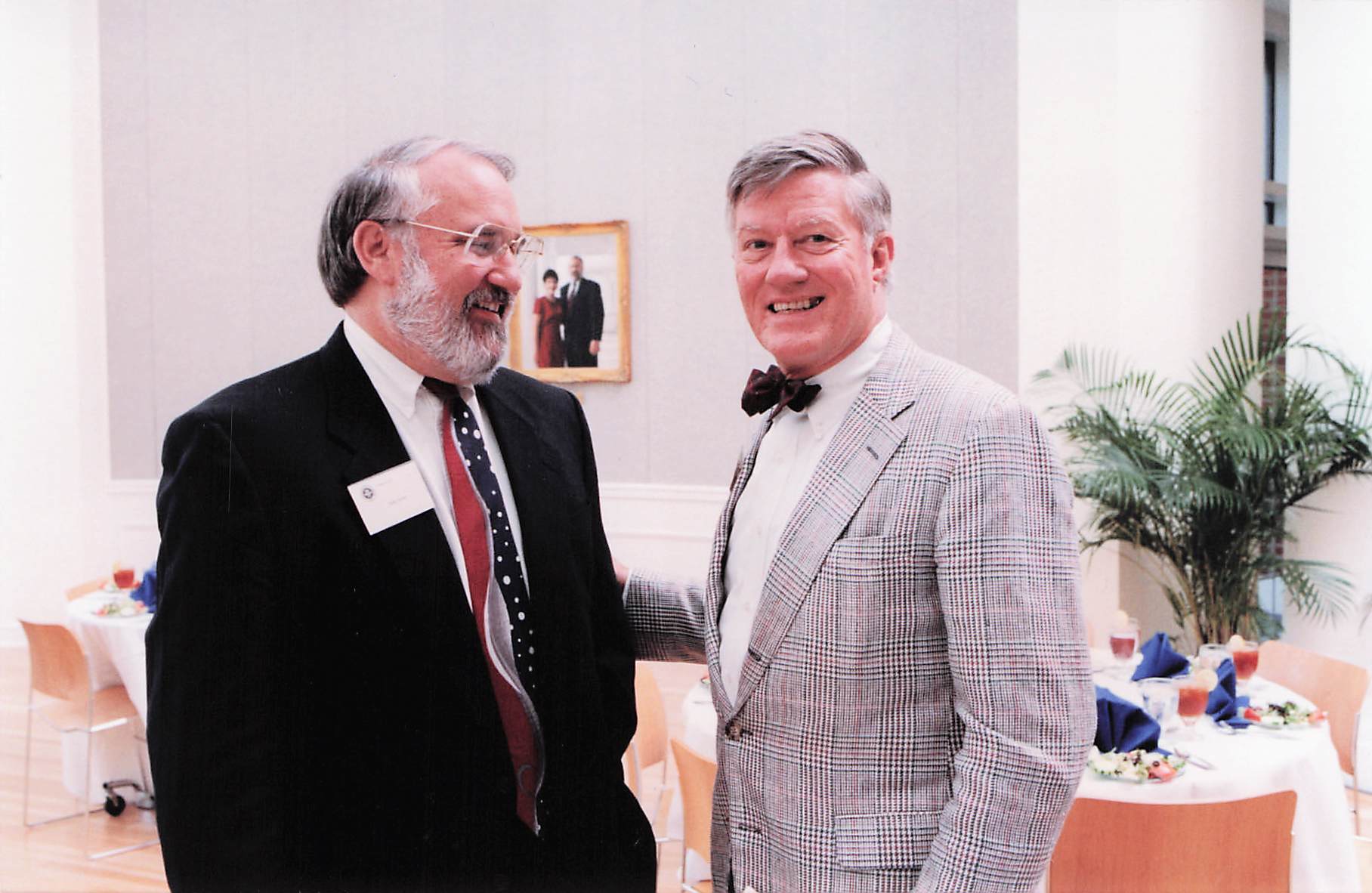
Beyond serving as Dean and President, D’Alemberte established himself as a significant figure nationally and internationally. In 2000, he supported efforts that helped lead to the U.S. Supreme Court’s first same-day release of oral-argument audio during the 2000 election litigation. From 1991 to 1992, he also served as president of the American Bar Association. In 1990, he co-founded the ABA’s Central and East European Law Initiative (CEELI), which has since become the ABA Rule of Law Initiative.
Sandy D’Alemberte received the ABA Medal, was president of the American Judicature Society, spearheaded revision of the Florida Court System, was the first chair of the Florida Commission on Ethics, and chaired the 1977–78 Florida Constitution Revision Commission.
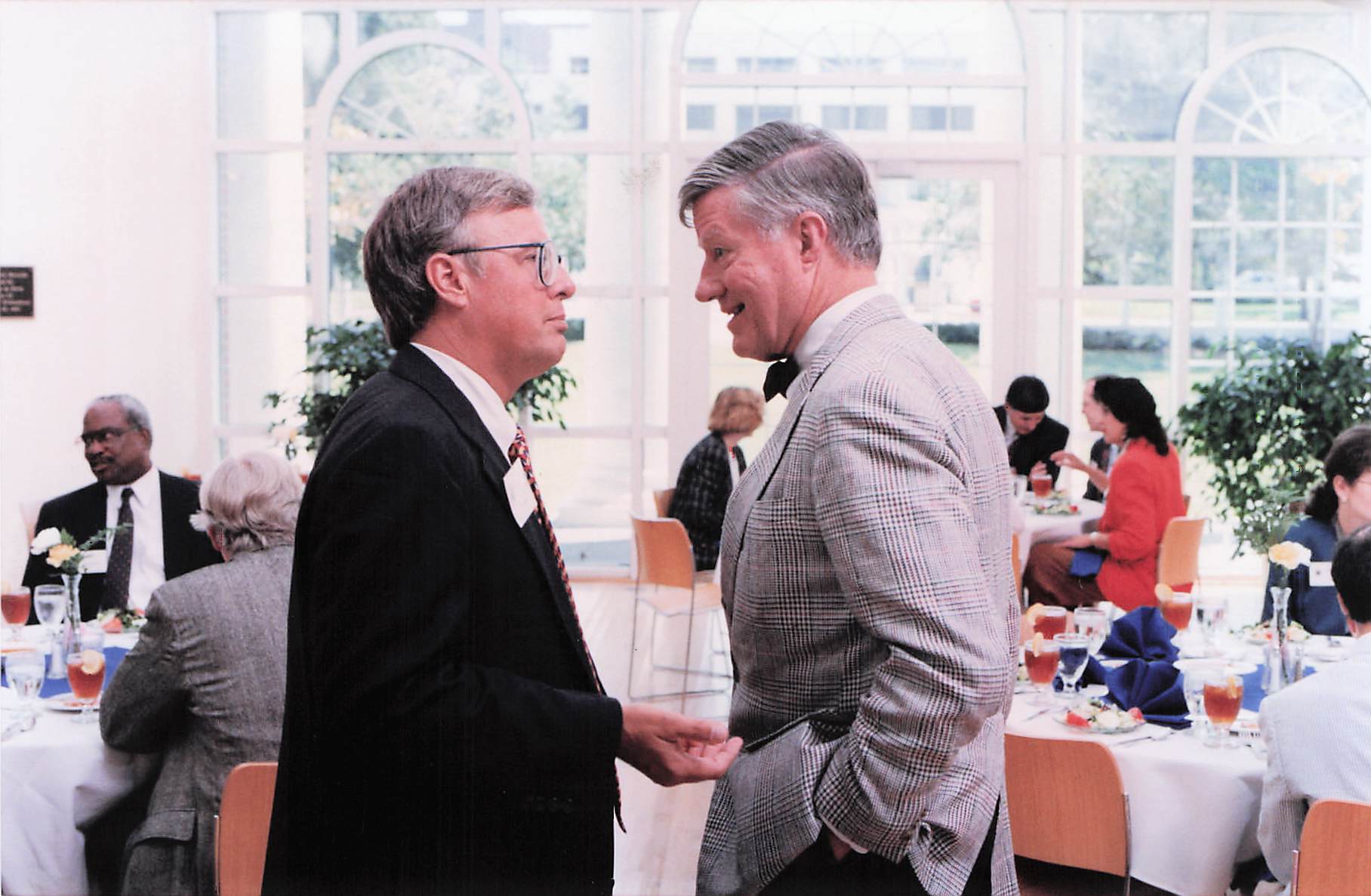
Today, D’Alemberte’s influence remains evident throughout the College of Law. In front of the Campus Building Steps, a bronze cast statue of D’Alemberte sits, greeting students as they enter. In 2026, the Talbot “Sandy” D’Alemberte Memorial Wall was unveiled on the third floor of the College of Law, reflecting the breadth of his career and the values that defined his leadership.
D’Alemberte on the FSU Law Timeline
1984
The Fourth Dean of FSU Law, Talbot "Sandy" D'Alemberte

Talbot “Sandy” D’Alemberte served as dean during a period of institutional momentum and statewide visibility. After serving as Dean of FSU Law, Sandy D'Alemberte continued to nurture his connection to FSU by serving as University President from 1994 to 2003.
1988
Law Rotunda is Dedicated
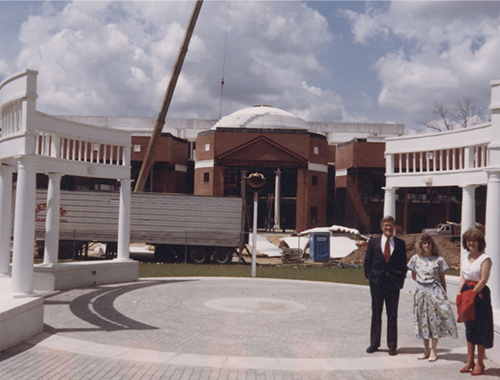
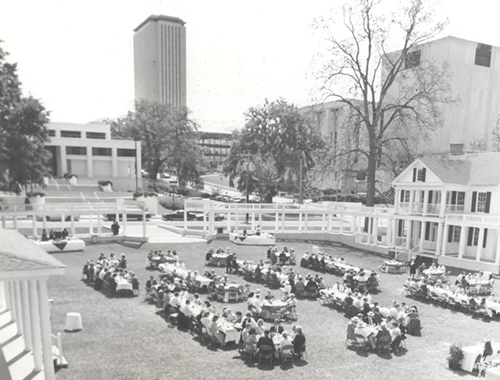

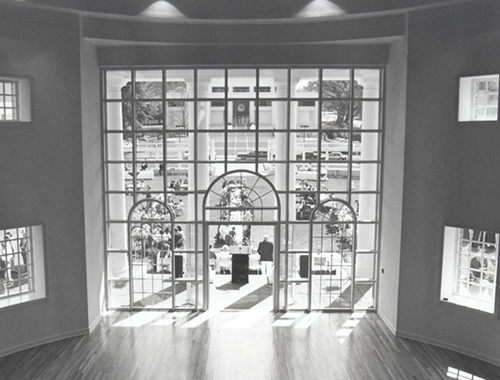
The D’Alemberte Rotunda at the Village Green is dedicated, becoming a central gathering and event space for the College of Law community.
2023
Sandy D'Alemberte's Legacy Honored
The College of Law continues Sandy D’Alemberte’s legacy in several ways, including two endowed scholarships in his name, the D’Alemberte-Ellis Fellowships, and the D’Alemberte & Palmer Lecture in International Human Rights.
The lecture series educates the community about the critical field of international human rights, inspires students, and contributes to the global discussion on human rights issues. The inaugural D’Alemberte & Palmer Lecture, held in 2023, featured Former General Counsel of the U.S. Navy Alberto J. Mora and coincided with the 75th Anniversary of the Universal Declaration of Human Rights.
2026
Unveiling the Talbot "Sandy" D'Alemberte Memorial Wall
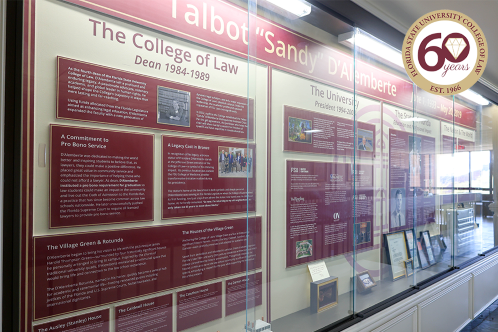
In tribute to the enduring legacy of Talbot "Sandy" D’Alemberte, our College unveiled a newly installed memorial wall located on the College of Law Campus. This dedicated display honors D’Alemberte’s remarkable life and the profound influence he had on the College of Law, Florida State University, and the broader legal and civic communities he served.
The memorial wall reflects the breadth of D’Alemberte’s career and the values that defined his leadership. Through photographs, milestones, and reflections, the installation invites students, faculty, and visitors alike to consider the example he set through a lifetime dedicated to justice, public service, and institutional integrity.
Remembering Sandy D’Alemberte