
FSU Students Help Shape Supreme Court Debate in Major Election Law Case
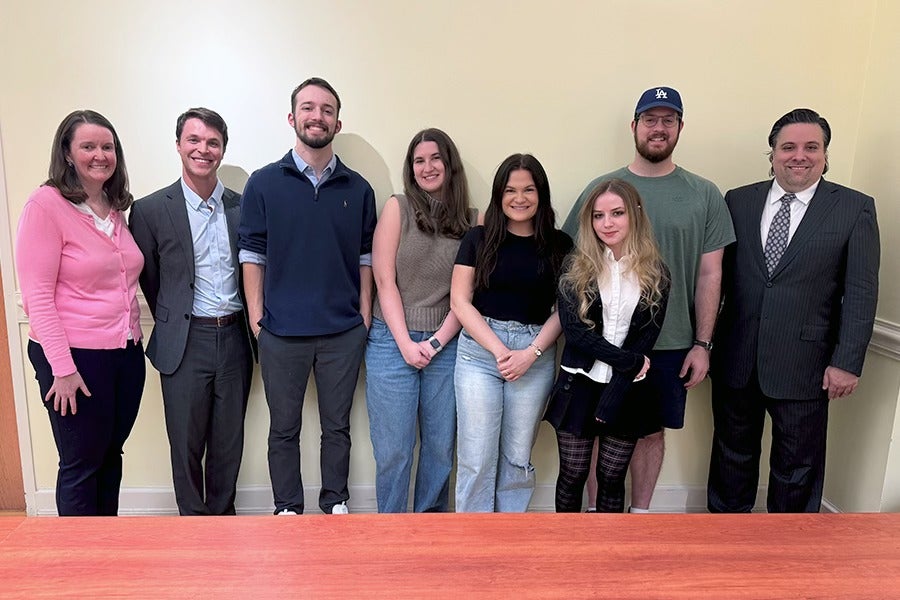
TALLAHASSEE, Fla. — Florida State University College of Law students didn’t just study Supreme Court cases this semester — they helped write a legal filing that was cited during oral arguments in a major election law case before the nation’s highest court.
Students in the Supreme Court Litigation course, taught by Michael T. Morley, Sheila M. McDevitt Professor of Law and FSU Election Law Center Faculty Director, and Maureen Wagner Vinson, FSU Election Law Center Executive Director, are gaining hands-on experience preparing briefs filed with the U.S. Supreme Court. Through the course, students engage directly in amicus advocacy, learn Supreme Court procedure and develop high-level legal writing skills.
As part of the FSU College of Law’s 2026 Supreme Court Litigation course, students worked alongside Professor Morley to file an amicus brief in Watson v. RNC, a case that asks the U.S. Supreme Court to clarify the meaning and scope of federal Election Day statutes — specifically, whether ballots received after Election Day in federal elections remain valid under federal law.
During oral arguments March 23, Supreme Court Justice Brett Kavanaugh referenced Morley’s brief and the position advanced by the FSU Election Law Center. The exchange underscored FSU Law’s growing reputation as a national leader in experiential legal education and election law scholarship.
For second-year law student Lauren Bina, hearing the brief cited in court was both unexpected and unforgettable.
“The feeling of going to that YouTube link and hearing Professor Morley’s name being cited by Justice Kavanaugh was surreal,” Bina said.
Third-year law student Spencer Moreno said the moment validated months of intensive legal research and drafting — work that mirrors what attorneys do in appellate practice.
“We are so busy working on other briefs and other things. That wasn’t necessarily something we were checking for,” Moreno said. “But once Professor Vinson alerted us, we were definitely very excited to see that. Just hearing Professor Morley’s name cited by a current Supreme Court Justice was almost like a jump scare.”
“Providing students with the opportunity to contribute to a case before the U.S. Supreme Court reflects the kind of hands-on, high-impact learning that defines the Florida State University College of Law,” said Erin O’Hara O’Connor, Dean of the FSU College of Law. “Through experiences like the Supreme Court Litigation course and the work of our Election Law Center, our students are not only studying the law — they are helping shape it while developing the practical skills needed to lead in a rapidly evolving legal landscape.”
“Providing students with the opportunity to contribute to a case before the U.S. Supreme Court reflects the kind of hands-on, high-impact learning that defines the Florida State University College of Law.”
– Erin O’Hara O’Connor, Dean of the FSU College of Law
Watson v. RNC centers on a Mississippi law that allows ballots postmarked by Election Day to be counted up to five days later. The Republican National Committee (RNC) argues that the policy is preempted in presidential and congressional elections by federal law, which establishes “Election Day” as a single day for federal elections.
To address that question, Professor Morley and his students examined congressional records dating back to the 19th century to uncover the original intent behind federal Election Day statutes.
“We were reviewing congressional record transcripts from the 1840s and the 1880s and piecing together the different floor statements that were made, the debates, the speeches, in order to tease out what the congressional purpose and the congressional intent was,” Professor Morley said of the team’s research.
The brief argued that the Supreme Court should interpret the statutes consistently with their original purpose: preventing voter fraud while preserving public confidence in election outcomes.
For Moreno, the fact that the Justices engaged directly with the argument captured the very purpose of filing an amicus brief.
“I think it was very, very surreal,” Moreno said. “I think it’s one of those things where you always hope they’re going to pay attention to what you say, that’s kind of the point of an amicus brief – you’re a friend of the court. You’re trying to bring up something that they’re not necessarily going to consider. The fact that they actually did read it and listened to our argument, we’re very pleased for sure.”
The brief’s citation elevates the national profile of the FSU Election Law Center and highlights the College of Law’s commitment to preparing practice-ready graduates capable of contributing to consequential legal debates.
From a Tallahassee classroom to the nation’s highest court, the experience is a reminder that student work at FSU can help shape the future of American election law.
The Center’s impact extends beyond the classroom. The FSU Election Law Center’s Spring Conference will be held in Washington, D.C., this year, bringing together the nation’s most preeminent election law scholars, leading policymakers, top litigators, election regulators and administrators, and other experts to tackle the most pressing issues affecting elections across the United States.
For more information about the Election Law Center, visit its website.